Firmware v75.4 · RTOS

Autonomous
Mesh Reality

Where GPS fails, Arttous creates its own reality. A 16-DOF quadrupedal platform powered by ESP32-S3 Dual-Core FreeRTOS and localised via T3S3 LoRa Mesh Time-of-Flight ranging.

System Notice: We are actively seeking kinematic specialists.
Registration grants access to the verify_protocol.
Complete calibration tasks to unlock community entry.

ESP32-S3 Dual-Core FreeRTOS· 16-DOF Kinematic Engine· SX1280 LoRa 2.4 GHz Mesh· Time-of-Flight Localisation· 50 Hz Core 1 Control Loop· MPU-6050 IMU Stabilisation· WebGL Digital Twin· PETG-CF / TPU 95A Chassis· MIT Licensed · Ontario CA· ESP32-S3 Dual-Core FreeRTOS· 16-DOF Kinematic Engine· SX1280 LoRa 2.4 GHz Mesh· Time-of-Flight Localisation· 50 Hz Core 1 Control Loop· MPU-6050 IMU Stabilisation· WebGL Digital Twin· PETG-CF / TPU 95A Chassis· MIT Licensed · Ontario CA·
Component Matrix
Hardware Rev 04 · Config: QUAD_16DOF
Status: Optimal · Bat: 7.4V 2S
Motion Engine
Symmetric Twist Kinematics
Custom Inverse Kinematics solver (v75.4) handling 16 degrees of freedom — 4 per leg. Corrects asymmetric roll using active twist-banking logic running on Core 1 at a strict 50 Hz loop. NaN-protection clamps prevent CPU crashes when a foot target exceeds leg reach.
// Decrypting matrices…
Actuation
0x
MG90S Servos
High-torque metal gear actuators. 4 motors per leg provide active ankle control and complex gait transitions at 50 Hz.
Localisation System
T3S3 LoRa Mesh
GNSS-denied navigation using SX1280 2.4 GHz LoRa modules. Robots deploy anchor nodes to triangulate position via Time-of-Flight with sub-metre accuracy — no satellite infrastructure required.
Anchor_A-42 dBm · 3.2 m
Anchor_B-38 dBm · 1.8 m
Anchor_C-45 dBm · 4.1 m
TriangulationLocked
Core Processor
ESP32-S3 (N8R8)
Dual-Core SoC running FreeRTOS. Core 1 is locked to physics at 50 Hz. Core 0 handles async WebSocket telemetry on Port 81 at 100ms intervals.
Stabilisation
Active Gyro — MPU-6050
Pitch: 0.02°
Real-time horizon correction via a dedicated I²C bus (GPIO 6/7). IMU feeds directly into the gait scheduler to adjust foot height on uneven terrain. Smoothing via smoothVx / smoothVy prevents abrupt leg parking and tipping on slopes.
Engineering Breakdown
Core 1 · FreeRTOS v10.4 · IK4=75.4
Memory Safety
stateMutex Protection
A FreeRTOS SemaphoreHandle_t stateMutex gates all shared memory access between TaskControl and TaskNetwork. This prevents race conditions when the web UI sends new gait parameters mid-cycle — a critical stability requirement for any real-time robotics system.
5ms
Semaphore timeout threshold
Power Architecture
Dual I²C Bus Split
PCA9685 servo driver (GPIO 4/5) and MPU6050 IMU (GPIO 6/7) operate on entirely separate physical I²C lines at 400 kHz. This eliminates I²C bus starvation — a critical bug in single-bus designs where high-frequency servo updates block IMU sensor reads, causing catastrophic stabilisation failure.
400 kHz
Per-bus clock speed
Gait System
Amplitude Decay
When joystick velocity approaches zero, gait amplitude decays organically rather than cutting abruptly. The formula smoothVx += (targetVx - smoothVx) * (4.0f × dt) creates natural leg parking transitions, eliminating the mechanical jolt that previously caused tipping on sloped surfaces during v68 field tests.
4.0f
Decay coefficient (tuned in field)
Kinematic Solver
Law of Cosines IK
The IK engine solves femur and tibia angles using the Law of Cosines at 50 Hz. NaN-protection clamps constrain the intermediate cosine value to [-1.0, 1.0] before the acos() call — preventing CPU exceptions and hard crashes when a foot target exceeds the physical reach of the leg mechanism.
20ms
Full IK solve cycle on Core 1
Connectivity
WebSocket Telemetry
Core 0 runs AsyncWebServer and an AsyncWebSocket handler simultaneously. Every 100ms, the robot broadcasts a compact JSON payload containing pitch, roll, battery voltage, per-anchor RSSI, and gait state — to any connected browser, served entirely from PROGMEM. No cloud server. No app.
100ms
Telemetry broadcast interval
Safety System
Gamepad Watchdog
A 500ms Gamepad Watchdog monitors controller signal continuity on Core 0. On input loss — Bluetooth dropout, browser tab switch, or network hiccup — the robot transitions to a graceful stand pose rather than freezing mid-gait. This prevents falls and mechanical stress on servos during unsupervised field operations.
500ms
Watchdog timeout to safe-stand
Firmware v75.4 Feature
Zero-Install
Digital Twin
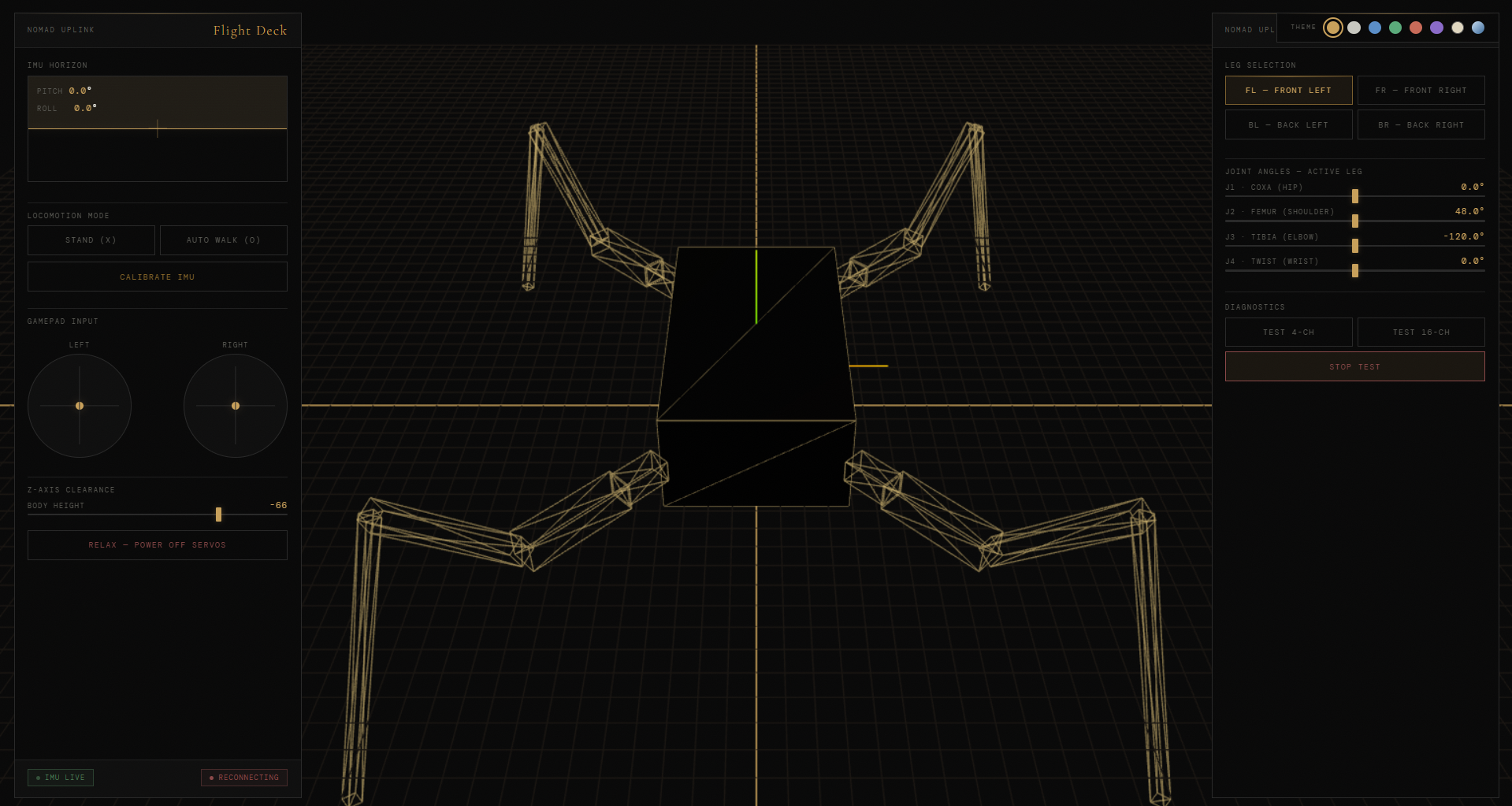
Command your fleet from any browser, anywhere. The Arttous ESP32-S3 serves a fully optimised WebGL interface directly from onboard PROGMEM — no app store, no install, no cloud dependency. The UI renders a real-time 3D wireframe of the robot's actual joint angles, updated live via WebSockets.
Render EngineThree.js WebGL
Telemetry Latency< 50ms WebSocket
Served FromESP32-S3 PROGMEM
Installation RequiredNone
Control InputHTML5 Gamepad API
Visual AxesCoxa · Femur · Tibia · Twist
Initiate Uplink
Digital Twin Interface
Application Domains
Target: GNSS-Denied Environments
01
Subterranean Inspection
Mine shafts, sewage tunnels, and utility conduits where GPS is unavailable and human entry is hazardous. Mesh anchors deployed at tunnel entrances provide relative coordinates without satellite infrastructure. Active IMU correction maintains stability on uneven rock surfaces.
02
Search & Rescue
Post-disaster structural entry where GPS canopy loss and debris-covered surfaces defeat wheeled platforms. The 16-DOF gait navigates rubble and irregular voids. Real-time WebSocket telemetry allows remote coordinators to guide operators with full sensor and visual awareness.
03
Agricultural Survey
Row-level crop inspection in dense greenhouse environments where GPS canopy interference degrades accuracy below useful thresholds. Mesh anchors placed along row ends provide precision lane-following. Onboard camera integration targets planned for Phase 3 swarm deployment.
04
Research & Education
An affordable, fully open-source platform for inverse kinematics research, swarm intelligence study, and embedded systems education. Full RTOS source code, PCB Gerbers, and all 3D models are publicly available under MIT License. Build costs target under $850 CAD per unit.
Research Disclaimer
Doc ID: Theory_01
Operator Disclosure — Read Before Deployment
0.1 Human-AI Hybrid Origin
The User acknowledges that content on Arttous is not the result of certified engineering standards (ISO/ASTM). It is the product of experimental collaboration between human enthusiasts and Generative AI. Consequently, the data may contain logical errors or physics calculations that function in simulation but fail in physical reality. This is a research platform, not a certified industrial product. Review the full data governance protocol before proceeding.
0.2 No Guarantee of Feasibility
We do not warrant that the 3D models are printable, structurally sound, or mechanically viable under real-world torque loads. We do not warrant that the firmware code (C++/Python) is free of bugs, memory leaks, or race conditions that could overheat or physically destroy hardware. All physical deployment is entirely at operator risk. Arttous Robotics Inc. accepts no liability for hardware damage, financial loss, or physical injury arising from use of any asset on this platform.
Execute: View_Human_Engineering_Archive.sh Enter →
Operational Logic
Deployment Sequence · v75.4
01
Deploy Anchors
Operator places 3 or more T3S3 nodes in the environment. The system auto-calibrates mesh geometry via FreeRTOS TaskNetwork using a Ping/Pong protocol over LoRa 2.4 GHz. A minimum of 3 anchors enables 2D triangulation; 4 or more provides 3D positioning with altitude awareness for multi-level environments.
02
ToF Ranging
Arttous calculates its distance to each anchor node using Time-of-Flight pulse timing at the speed of light. The SX1280 chipset achieves sub-metre ranging accuracy without satellite infrastructure. RSSI signal strength provides a secondary distance estimate used for error correction and anchor-quality scoring.
03
Path Execution
The kinematics engine on Core 1 translates position coordinates into 16-motor servo commands at 50 Hz. Active IMU correction adjusts individual foot heights in real time for uneven terrain traversal. All sensor data, joint angles, and positional estimates are streamed live to the Digital Twin interface via WebSocket.
Join the Mesh
The Arttous Mesh is a growing community of engineers, makers, and researchers building the next generation of affordable autonomous robotics. Register as a Specialist to gain access to private firmware branches, CAD revision files, hardware preview documentation, and the operator Discord.
Specialists who complete verification calibration tasks earn commit access to the RTOS firmware repository and are listed in the project's public contributor registry. Skills in FreeRTOS, inverse kinematics, PCB design (KiCad), or Three.js are particularly valued by the core team.
420
Repository Commits
1.8k
GitHub Stars
310
Repository Forks
50+
Active Operators